

Managing a signage rollout means coordinating the design, permitting, fabrication, and installation of new or updated signs across one or many locations, so every site ends up on-brand, on-code, and on-schedule. The more locations and municipalities involved, the more the job shifts from a single project to a logistics program, and the more a clear process matters. Here’s how a successful rollout actually comes together, and where they most often go wrong.
What Is a Signage Rollout?
A signage rollout is the implementation of new or updated signage across one or more locations, usually tied to a brand launch, a refresh, or a full rebrand. A single-location update is a project. That same update across fifteen or twenty locations is a different kind of work entirely: the design has to translate to each building, the permits have to clear multiple municipalities with their own codes, and the installs have to land on dates that don’t disrupt each location’s operations.
That jump in complexity, from one site to many, is where most rollouts either succeed or stall. The steps below walk through the process with that multi-site reality in mind.
Where Multi-Site Rollouts Go Wrong
Before the step-by-step, it helps to know the three things that derail rollouts most often, because nearly every decision in the process traces back to one of them:
- Optimistic timelines. A schedule built on what’s convenient rather than on real lead times and real permitting durations will slip, and on a multi-site program one slip cascades into the next.
- Permitting surprises. Permitting is where rollouts stall. Each municipality has its own code, submission requirements, and turnaround, and the slow or variance-requiring sites need to be flagged at the start, not discovered late.
- Vendor handoffs. When design, fabrication, permitting, and installation live with different vendors, weeks disappear in the gaps between them. The fewer handoffs, the fewer the surprises.
How to Manage a Signage Rollout, Step by Step
1. Lock down brand standards before anything is fabricated
Every downstream decision references your brand guidelines, so they need to be clear, documented, and in the hands of everyone who needs them before fabrication starts. That means exact color specifications, approved sign types, vector files of your logos, and a clear line between what’s fixed across every location and what’s allowed to vary site to site. If franchisees are procuring their own signage, make sure each one has the spec to hand their installer. Starting a production run before standards are locked is the most expensive mistake on this list, because the error repeats at every location.
2. Scope the program and survey every site
Before anything is built, define the full program: every location, the sign types at each, what existing signage comes down, and what goes up. Then survey the sites. A site survey captures what’s actually buildable, the setbacks, sight lines, electrical, and access constraints, along with the allowable signage under each municipality’s code. Scoping a rollout from a spreadsheet without surveys is how you end up with a sign that’s fabricated but can’t be permitted or installed as designed. (This is also the stage to involve a site survey and permitting partner if you’re using one.)
3. Adapt the design to each location and its code

Your brand has to read the same at every location even when the buildings, settings, and sign types don’t match. A monument sign that fits one municipality’s size limits may need a different footprint in the next town over. The design team’s job is to adapt the brand to each site’s architecture, setback, and code, and to document how it adapts, so the visual standard holds whether a customer is looking at a pylon at one site or channel letters at another. Work this out before fabrication, not during it.
4. Build a realistic, phased schedule
A schedule is only useful if it’s honest. Build it on the actual lead time for each sign type, the actual permitting timeline for each municipality, and the actual availability of install crews, not on what would be convenient. Permitting is usually the gating factor and the hardest to predict; it can run from a couple of weeks to several months depending on the jurisdiction. Identify the slow sites and the ones that may need a variance up front, and phase production so signs are built to match their install dates rather than sitting in storage or holding up the line. An honest fourteen-week timeline beats a ten-week timeline that slips.
5. Coordinate site access and installation
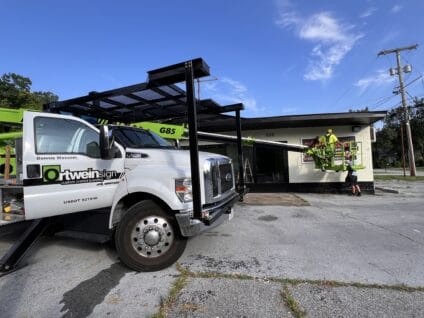
The logistics that actually make or break an install date are the unglamorous ones: crane and lift access, building entry, after-hours windows, and coordination with the store manager or local staff on site. Confirm them ahead of each location. On a single install a missed detail costs a day; across a rollout it costs a chain reaction. Once access is confirmed and the signs are fabricated, the crew gets the go for installation day.
6. Document completion and plan for what comes next
For each site, capture installation photos and whatever documentation you, your local representative, or the municipality need for sign-off, occupancy, or internal records. And recognize that a rollout isn’t the end of a project; it’s the start of a maintenance relationship. Signs need service, tenants turn over, and locations get added. Planning for that from the outset, rather than treating completion as the finish line, is what separates a one-time job from a program that stays consistent over years.
How Long Does a Signage Rollout Take?
It depends on three things: how many locations, how many different sign types, and how many municipalities are involved. Fabrication is rarely the bottleneck; permitting is. A handful of sites in cooperative jurisdictions can move in a couple of months, while a large program spanning many municipalities, some requiring variances, can run considerably longer. The honest answer for any specific program comes after the sites are surveyed and the permitting picture is clear, which is exactly why scoping and surveying come first.
Should You Use One Sign Company or Several?
You can run a rollout through several regional sign companies, and for very large national programs that’s sometimes unavoidable. But every additional vendor adds a handoff, and handoffs are where timelines and brand consistency break down. A single full-service partner, one that handles design, permitting, fabrication, and installation under one roof, gives you one point of accountability for the whole result instead of a different company at every site. That’s the core of what we do on our multi-site signage rollouts and rebrands, and it’s the single biggest factor in whether a multi-location program lands on schedule.
Ready to Plan Your Rollout?
If you’re coordinating signage across more than a few locations, more than one municipality, or more than one phase, we can help you scope it realistically and run it end to end. Call us at 1-866-867-9208 or request a quote with whatever details you have, and we’ll come back with an honest next step.