

A monument sign is often the first impression your property makes and, ideally, a landmark people use to find you. But one early decision shapes how that sign performs every hour of the day: should it be illuminated or not?
It’s tempting to treat this as a budget question, where lighting is the upgrade and no lighting is the cheaper default. In practice it’s a design and performance question. The right answer depends on how visible you need to be after dark, what your brand should communicate, the environment around the sign, and what you’re willing to maintain over the next decade. Below we walk through each of those factors so you can make the call with confidence rather than guessing.
A Quick Refresher: What Is a Monument Sign?
A monument sign is a low-profile, freestanding sign built as a single architectural unit rather than mounted on posts. It typically sits at or near eye level, anchors into a footer at ground level, and is finished to complement the building or landscape around it. Churches, hotels, medical facilities, schools, retail centers, and corporate campuses all rely on them to mark an entrance with a sense of permanence.
That permanence is exactly why the illumination decision matters so much. A monument sign isn’t something you swap out in a year or two. Whatever you decide about lighting, you’ll live with it for a long time, which is worth keeping in mind as you read on. (For the difference between monument and pylon signs, see our separate guide.)
What Counts as an Illuminated Monument Sign?

Illumination covers a wider range than most people expect, and it does not have to mean “bright.” A few common approaches:
- Internally illuminated cabinets, where the sign face glows evenly from within.
- Halo or reverse-lit lettering, where light washes the wall behind dimensional letters for a soft, premium glow.
- External or ground lighting, where fixtures wash the face of an otherwise unlit stone or masonry monument.
- Integrated digital displays, where an electronic message center becomes part of the monument structure.
The important point that many competitors miss: a softly illuminated monument can look more upscale at night than an unlit one, not less. Illumination is a design tool, not just a visibility switch. Done with restraint, it reads as quality.
What Counts as a Non-Illuminated Monument Sign?

A non-illuminated monument relies on its materials, form, and surroundings rather than built-in light. These signs lean on stone, brick, dimensional lettering, and landscaping to make their statement, and they often feel timeless and architecturally integrated as a result.
They’re a natural fit for parks, neighborhoods, historic districts, government buildings, and any setting where understatement is the goal. The mistake is to think of non-illuminated as simply the lower-cost option. A well-built non-illuminated monument can be a substantial, premium piece. What it gives up is independent nighttime presence, and whether that matters comes down to the factors below.
Visibility: Day vs Night Is the Real Question
This is the heart of the decision. During daylight, a well-designed monument of either type performs well. The gap opens after dark.
Several conditions push toward illumination:
- Roadside and highway-adjacent locations, where drivers approach at speed and need to register your sign quickly.
- Longer setbacks, where the sign sits far from the road and ambient light won’t reach it.
- Darker winter evenings, when much of your drive-by traffic happens after sunset for months at a time.
- Extended operating hours, where customers are arriving when it’s already dark.
Other conditions make non-illuminated perfectly viable:
- Walkable downtown districts with strong existing street lighting.
- Daytime-only operations, like many offices, schools, and civic buildings.
- Locations with significant surrounding light, where an unlit monument still reads clearly at night.
A useful way to frame it: a monument sign at a highway entrance has very different visibility demands than one in a lit, pedestrian-scale downtown. Match the lighting decision to how and when people actually approach your property, not to a general rule.
Branding and Customer Perception

Beyond raw visibility, illumination sends a message about who you are. This is where the choice becomes a branding decision, not just a technical one.
An illuminated monument tends to communicate activity, accessibility, modern branding, and the sense that you’re open and engaged, well-suited to businesses that want to feel current and available after dark.
A non-illuminated monument tends to communicate permanence, tradition, sophistication, and understated confidence, well-suited to organizations whose identity rests on stability and architectural integration rather than visibility-driven marketing.
Neither reading is better in the abstract. A boutique medical practice and a 24-hour convenience store should almost certainly land in different places, and that’s the point: let the sign say what you actually want said.
Maintenance and Long-Term Cost
Lighting adds components, and components eventually need attention. Being honest about this up front prevents disappointment later.
An illuminated monument carries a higher upfront cost and a small set of serviceable parts: the lighting elements themselves, photocells or timers, and wiring. The upside is that modern LED systems have long service lives and low energy draw, so ongoing operating costs are modest, and good design keeps service visits infrequent.
A non-illuminated monument has fewer components and lower operating costs, but two things still deserve attention. First, landscaping around the base needs upkeep to keep the sign looking intentional rather than neglected. Second, if you want any nighttime presence at all, you’ll likely depend on external lighting, which has its own (modest) maintenance.
The balanced takeaway: illumination isn’t a maintenance burden to fear, and non-illuminated isn’t maintenance-free. Plan for the realistic upkeep of whichever you choose, and neither will surprise you.
Which Businesses Tend to Benefit From Each
Patterns emerge by industry, though they’re starting points rather than rules.
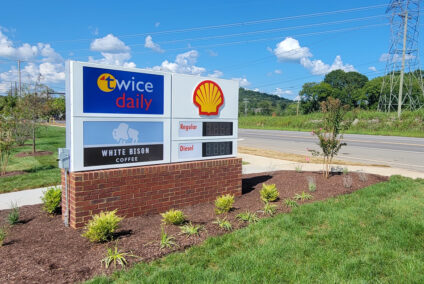
Illuminated monument signs tend to suit hotels, convenience stores, hospitals and urgent care, restaurants, entertainment venues, and shopping centers, all of which serve customers after dark and benefit from strong nighttime presence.
Non-illuminated monument signs tend to suit churches, schools, parks, residential developments, civic buildings, and professional offices, where daytime visibility is sufficient and an understated, architectural look reinforces the brand.
If your organization sits on the line, that’s usually a sign the combined approach below is worth considering.
And if you’re making this decision across a portfolio of locations rather than one site, it stops being a single design choice and becomes a brand standard you set once and apply everywhere. That is its own discipline, which we cover in our guide on how to manage a multi-site signage rollout.
You Don’t Have to Choose Strictly Either/Or
Some of the most effective monument signs blend both philosophies, which is where custom design earns its keep. A few approaches worth knowing about:
- A masonry or stone monument washed by external ground lighting, keeping the natural material look while gaining nighttime visibility.
- Halo-lit dimensional lettering on an otherwise unlit structure, for a premium glow without an internally lit cabinet.
- Partial illumination, lighting only the logo or primary name while leaving the rest dark.
- A digital message center integrated into a traditional monument body, pairing permanence with the flexibility to update messaging.
- Low-voltage landscape lighting that lights the sign and its surroundings together as one composition.
These hybrids let you tune visibility, brand feel, and cost rather than treating the decision as binary. They’re also where having an experienced design team matters most, since the goal is for the lighting to feel like part of the design rather than something bolted on.
The Bottom Line
The best monument sign isn’t always the brightest one. It’s the one designed specifically for how your property functions and how customers experience your location. Work backward from your visibility needs, your operating hours, the environment around the sign, the brand impression you want, and the upkeep you’re prepared to maintain, and the illuminated-or-not question tends to answer itself.
If you’d like help thinking it through for a specific site, our design team can walk the property with you and recommend an approach built around how people actually arrive, day and night.